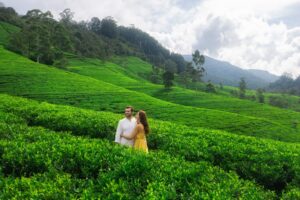
There’s a category of travel experience so universally agreed upon that debate is pointless – the kind that makes it onto every list, gets photographed from every angle, and still somehow exceeds expectations when you’re actually there. Sri Lanka’s hill country train journeys belong in that category. Not because they’ve been hyped into something they’re not, but because the reality of looking out the window as the train rounds a corner above a valley filled with tea estates is one of those moments that genuinely stops you mid-thought.
Sri Lanka’s railway network is old, occasionally unpredictable, and utterly charming. Here is how to make the most of it.
The Main Event: Kandy to Ella
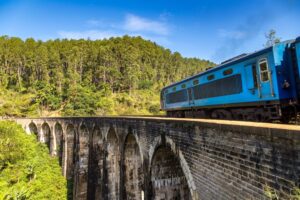
If you do one train journey in Sri Lanka, it’s this one. The route runs from Kandy through Nanu Oya (the station for Nuwara Eliya) and on to Ella, covering around 160 kilometres of some of the most dramatic highland scenery on the island. The train climbs through cloud forest, skirts cliff edges, crosses stone viaducts over jungle canopy, and passes through tunnels that plunge the carriages into brief, theatrical darkness before releasing them back into sunlight and open hillside.
The journey takes between five and seven hours depending on the service – and every minute is justified. There are moments where the train rounds a bend and a view opens across a valley so wide and green it feels unreal. There are stretches where you can lean out of an open doorway (a deeply unofficial but universally practised activity) and feel the cool highland air and watch tea pickers moving through the rows below.
Book reserved seating in advance. The observation car and second-class reserved carriages both offer good window views. First class exists but the windows don’t open – and in this case, open windows are the point.
The Nanu Oya to Ella Segment
If a full Kandy to Ella journey doesn’t fit your itinerary, the Nanu Oya to Ella leg alone is worth prioritising. This section – roughly three hours – carries the train through the highest elevations of the route and delivers the most concentrated stretch of landscape. The Nine Arch Bridge just outside Ella, where trains cross a stone viaduct above dense jungle, is best photographed from the embankment beside the track. Arrive 20 minutes before the scheduled crossing and wait; the combination of the bridge, the train, and the surrounding greenery produces images that hold up even when reviewed back home.
Colombo to Kandy – The City Fades, the Hills Begin
Less celebrated but still very much worth taking, the Colombo to Kandy service offers a different kind of pleasure: the visible transformation of landscape as the train leaves the coastal flatlands and begins its ascent into the highlands. The journey takes about two and a half hours and passes through rubber plantations, river valleys, and the first stretches of hill country before arriving at Kandy station – which sits in a cutting below the town and requires a short tuk-tuk ride up to the main streets.
Take the Intercity Express for the smoothest and fastest version. Morning departures from Colombo Fort station offer the cleanest light for the first half of the journey.
Colombo to Galle – Coast the Whole Way
Running south along the western coast from Colombo to Galle, this route offers something entirely different from the hill country experience: two and a half hours with the Indian Ocean appearing and disappearing on one side, coconut palms lining the track on the other, and the occasional fishing lagoon reflecting sky and cloud. The train stops at a string of coastal towns – Kalutara, Beruwala, Bentota, Hikkaduwa – each one tempting enough to warrant a separate visit.
This is one of the most enjoyable ways to travel the west coast – cheaper and more atmospheric than a car, and with the added advantage of being able to walk to the dining car for a cup of tea while the coast rolls by outside. Sit on the ocean side; left when heading south from Colombo.
Practical Advice for Riding Sri Lanka’s Railways
Book Ahead
Reserved seats on popular routes – particularly Kandy to Ella – sell out days and sometimes weeks in advance. Book through the official Sri Lanka Railways website or through a reliable local agent. Unreserved seating is available but standing for five hours through the hill country is a significantly less enjoyable proposition.
Timing Matters
Morning trains on the Kandy to Ella route offer the best light for photography and the clearest views before afternoon cloud rolls in across the highlands. If you can only choose one train, choose the early departure.
Don’t Rush It
Sri Lankan trains run on their own schedule. Delays happen. Build buffer into the days on either side of any train journey and resist the temptation to book something that requires you to be somewhere else within an hour of arrival. The train arriving late into Ella with the mist settling across the valley and the evening light going gold is not a problem. It is the experience.
Stand at the Door
Between stations, the connecting doors between carriages are often left open. Standing here – holding the rail, feeling the air, watching the track curve away behind you into the forest – is one of those small, uncomplicated pleasures that travel occasionally delivers. Do it.
Beyond the Famous Routes
The railway network extends beyond the hill country and the coast. The line north to Jaffna, restored to service in recent years, passes through a landscape quite different from the tropical south – flatter, drier, with a different quality of light. The Trincomalee line offers another east-coast option for those with time. Sri Lanka’s trains, at their best, don’t just move you from place to place – they reframe the journey itself as the destination. In a world where the instinct is always to arrive faster, that is a more valuable thing than it sounds.